Teacher Packet
Ruth Asawa
GRADE LEVEL: Early Elementary School (K-3), Elementary School (4-5), Middle School (6-8), High School (9-12)
Download PDF (Free)
We’re open Pride weekend! See our visitor tips …
We’re open Pride weekend! See our visitor tips …
Teacher Packet
Lesson
Objective: Students will explore primary documents, like Chiura Obata’s paintings, to understand the severity of the 1906 SF Earthquake.
Background Information
Scholars often refer to the Tang (618–907) and Song (960–1279) dynasties as the “medieval” period of China. The civilizations of the Tang (618–907) and Song (960–1279) dynasties of China were among the most advanced civilizations in the world at the time. Discoveries in the realms of science, art, philosophy, and technology—combined with a curiosity about the world around them—provided the men and women of this period with a worldview and level of sophistication that in many ways were unrivaled until much later times, even in China itself.
Video
Watch artist Kong Pak-yu demonstrate brushpainting at the Asian Art Museum.
Lesson
Students will consider the ways art can be used as activism in the context of Environmentalism and National Park Preservation.
Background Information
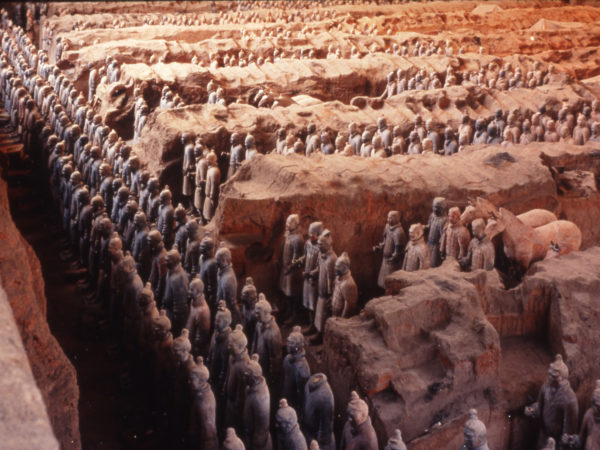
The Qin empire(221–206 BCE) of China lasted only fifteen years, but the rise of the state of Qin began several decades earlier, and Qin’s defeat of all the other rival states brought a definative conclusion to the Warring States period (475–221 BCE). Ying Zheng, the future First Emperor, ascended the throne of Qin in the year 247 BCE at age thirteen, and only a few years later launched a series of military campaigns against the neighboring states of Han, Zhou, Wei, Chu, Yan and Qi, defeating the last in 221 BCE, ‘as a silkworm devours a mulberry leaf ’ according to the Han historian Sima Qian.
Activity
Chinese operas are very long and feature complex narratives with a large number of characters. Have fun coloring in these sheets based on Chinese opera prints in the Asian Art Museum’s collection.
Background Information
Islam is one of the world’s major religions. It shares with Judaism and Christianity a belief in a single god. The Arabic name for God is Allah. The word Islam means “surrender (to God).” The followers of Islam are called Muslims, which in Arabic means “one who surrenders to God.”
Teacher Packet
Background Information
We will refer to Ancient China as the time between the Neolithic period (ca. 6,000‒ ca. 1750 BCE) and the Han dynasty (206 BCE‒ 220 CE), which is roughly equivalent to the period of the Roman Empire in the West. This is the formative stage of Chinese civilization. During this time, what we now call China developed from a collection of isolated cultural communities to a set of organized states which eventually coalesced around the idea of a single unified state, and then expanded to include contact with other civilizations.