Lesson
Legacies that Live On - The Terracotta Warriors
Students will diagram the influences and legacy of the First Emperor and create a 21st century genome of a local legacy based on similar concepts of influences and inspiration.
Lesson
Students will diagram the influences and legacy of the First Emperor and create a 21st century genome of a local legacy based on similar concepts of influences and inspiration.
Lesson
By constructing a graph that visually reflects a time span, students will gain a basic understanding of BCE and CE and specifically when key events happened in Afghanistan.
Artwork
Katsura River Style Flower Basket, approx. 1870-1920. By Iizuka Hosai I (1851-1916). Bamboo (madake), selected techniques: twill plaiting, diamond twill base. Lloyd Cotsen Japanese Bamboo Basket Collection, 2006.3.49.
Artwork
Jatayus, the heroic king of the vultures, attempts to prevent Ravana from abducting Sita, from the Ramayana (Story of Rama), approx. 400–500. India; probably Uttar Pradesh state. Terra-cotta. Gift of the Connoisseurs’ Council, 1988.40.
Artwork
Jatayus (Jatayu), king of the vultures and aide to Rama, approx. 1970. Indonesia; Cirebon, West Java. Wood, cloth, and mixed media. From the Mimi and John Herbert Collection, F2000.86.49.
Artwork
Jar, approx. 1600. Korea. Joseon Dynasty (1392-1910). Porcelain with transparent glaze. The Avery Brundage Collection, B60P110+.
Video
See demonstrations of employing both traditional (no electric needles!) and modern techniques. Joining Horitaka’s diverse, talented crew of tattooists are special guests from Japan — Shige, a powerhouse tattoo artist who has been showcased all over the world; Mutsuo, who’s designed for Bathing Ape and Hysteric Glamour; and Kazunobu Nagashima, a client of Shige who will proudly display his backpiece, which won a 2007 Milano Tattoo Convention award.
Background Information
Learn about Japan’s refined form of floral arrangement, known as ikebana (“to arrange and give life to flowers”).
Background Information
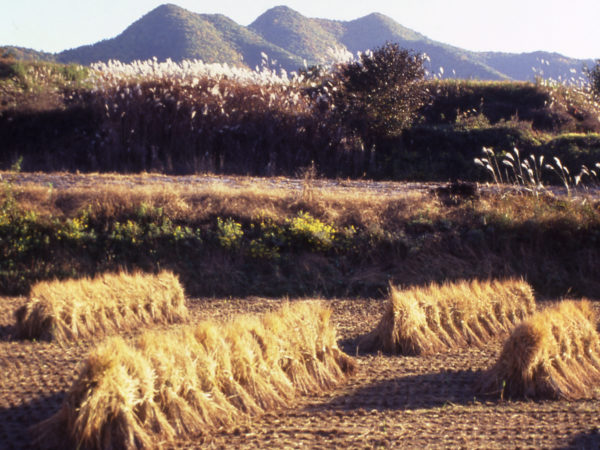
This image shows mountains and harvested rice in the autumn near the village of Andong in South Korea. Andong has been preserved as a traditional village, and exhibits both upper- and lower-class houses from the Joseon dynasty (1392–1910). The Korean peninsula is filled with mountains. Mountains form natural barriers and also create distinctive regions within Korea. Rice is a staple crop in Korea. Land formed the basis of wealth for most of Korean history. Rice was harvested not only for food, but also to pay for taxes.
Artwork
Illustrations of Buddhist texts and ritual formulas (Rashmivimla-vishuddhiprabhasa-dharani-sutra) (Mugujeonggwang Daedarani), 2001, by Dong-uArtist: Myeongcheon. Korea. Handscroll; sutra, gold on paper. Gift of Dong-u seunim, 2002.12.2.